
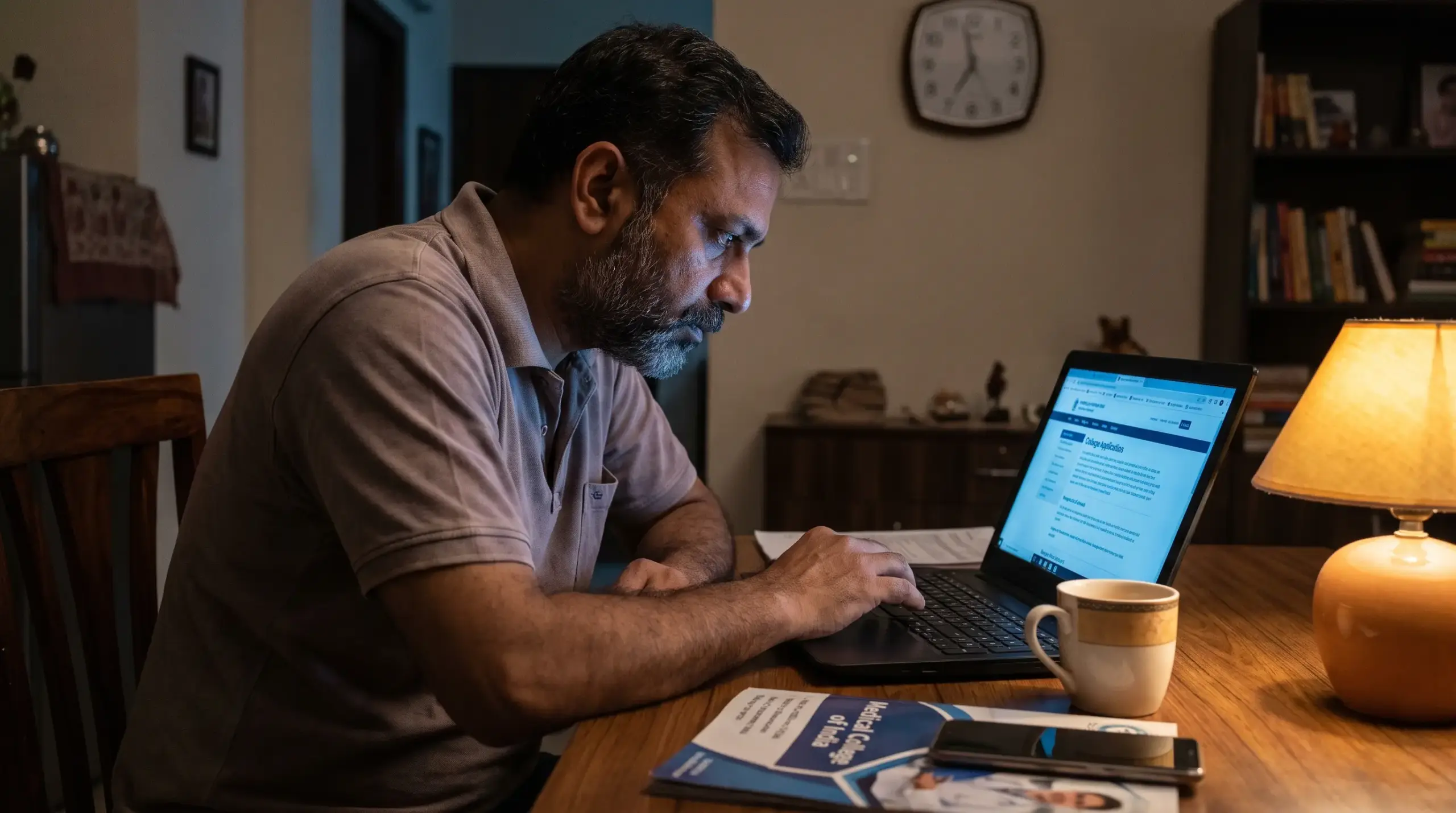
It is 1 a.m. in Kanpur, and Rakesh has not slept.
On his laptop is a brochure his son’s counsellor sent that evening. Glossy. Confident. A red stamp across the top: “MBBS in Philippines — now 100% NMC-compliant, 2026.” Below it, a screenshot of a resolution passed by the Philippine parliament. Beside it, a letter from something called CHED. His son Aarav cleared NEET last month. The counsellor was warm on the phone. “Sir, book the seat by Friday — only two left.”
And yet Rakesh cannot press pay. Something in his chest will not let him. So he types six words into Google: is MBBS in Philippines really valid.
If you are the student — or the parent — reading this at your own 1 a.m., this is written for you. Not to scare you. To hand you the one question that decides everything, straight from the official record, so that whatever you choose, you choose it with your eyes open.
First, the thing no brochure will tell you: there is no “MBBS” in the Philippines
Read that again, because everything turns on it.
The Philippines does not award an MBBS. It never has. What a student actually does there is two separate degrees, one after the other: first a pre-medical Bachelor of Science (BS) or Bachelor of Arts (BA) — a college degree, not a medical one — and only then a four-and-a-half-year Doctor of Medicine (MD).
So when an advertisement says “MBBS in Philippines,” it is describing something that does not exist. It is a convenient label pasted onto a BS/BA-plus-MD path because “MBBS” is the word Indian families search for. That single mislabel is where most of the confusion — and most of the risk — begins.
This matters for a very practical reason. India’s medical regulator does not care what a brochure calls the course. It cares about the structure underneath. And that structure is judged against one rulebook.
The one rulebook that decides your future: FMGL 2021
If you study medicine abroad and ever want to come home and practise in India, your entire future rests on a single regulation: the National Medical Commission’s Foreign Medical Graduate Licentiate (FMGL) Regulations, 2021[1]. (The regulator is the National Medical Commission — the NMC.)
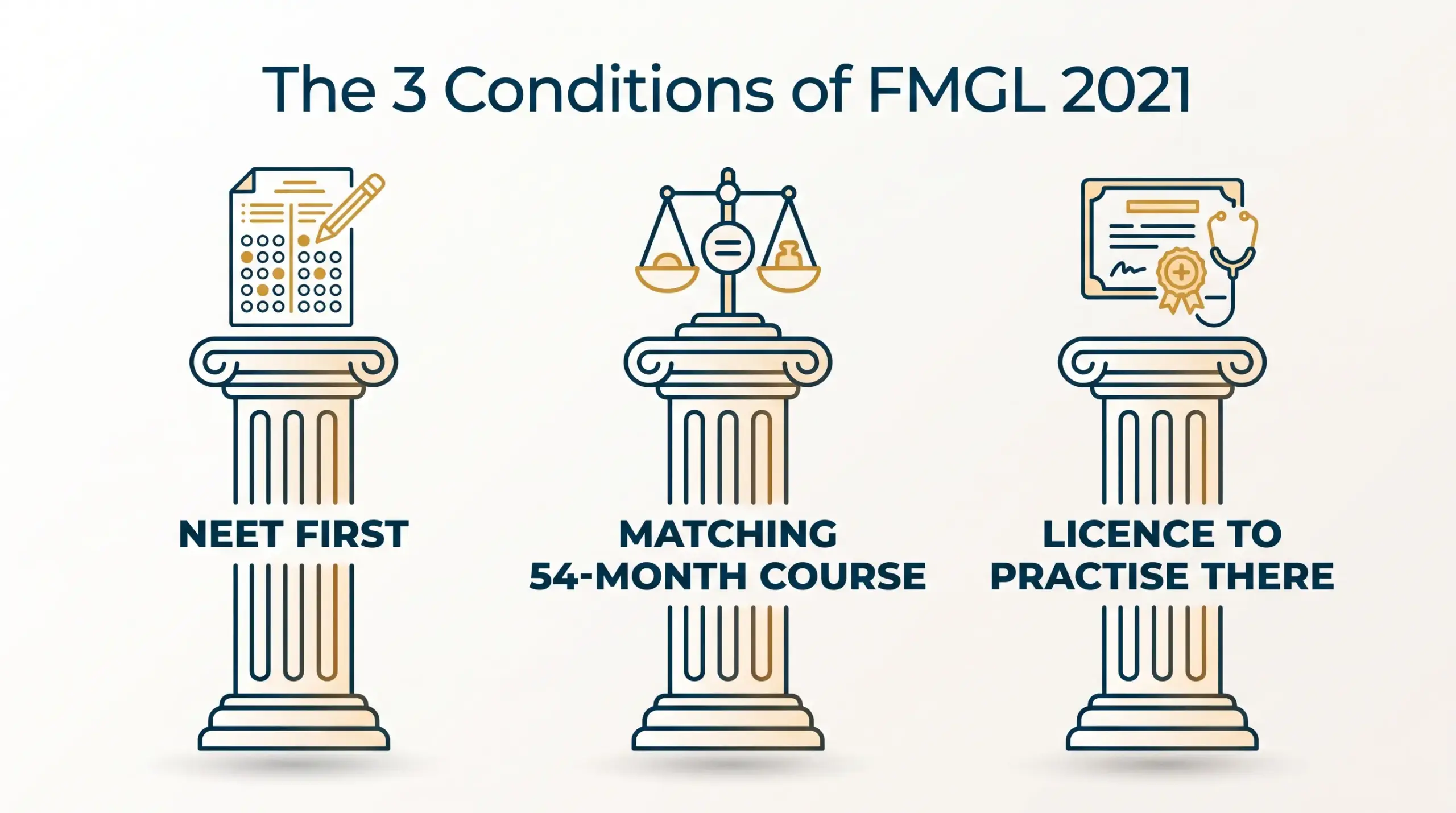
You do not need to read all of it. You need to understand what the government keeps repeating in plain language. The Union Health Minister laid it out in Parliament as three simple conditions any student going abroad must satisfy[4]. They are worth pinning to your wall:
The three conditions the government insists on
- Clear NEET first. You must qualify NEET before you take admission abroad. No NEET, no eligibility to ever practise in India — no matter which country you study in.
- Go only where the course matches India’s. The foreign programme must be equivalent to the Indian MBBS in structure — the recognised benchmark is a course of at least 54 months, with the required subjects, and the whole thing completed in the same institution and country.
- You must be able to get registered to practise as a doctor in that country. Not just graduate. Actually be eligible for a licence to practise medicine there, on the same terms as that country’s own citizens.
Look at the first two, and the Philippines looks fine. Aarav has his NEET score. And the Philippine authorities say their 54-month MD ticks the structure boxes — more on that in a moment.
It is the third condition where the whole thing quietly falls apart. And almost no brochure will show you why.
The pillar the Philippines fails today: you cannot get licensed to practise there
Think of it like a driving licence between two countries. A licence is only worth something if the two countries agree to honour each other’s drivers. If Country A refuses to let Country B’s citizens drive, then Country B, in fairness, refuses the same in return. No agreement, no licence — no matter how well you drive.
That is exactly the situation for an Indian student in the Philippines.
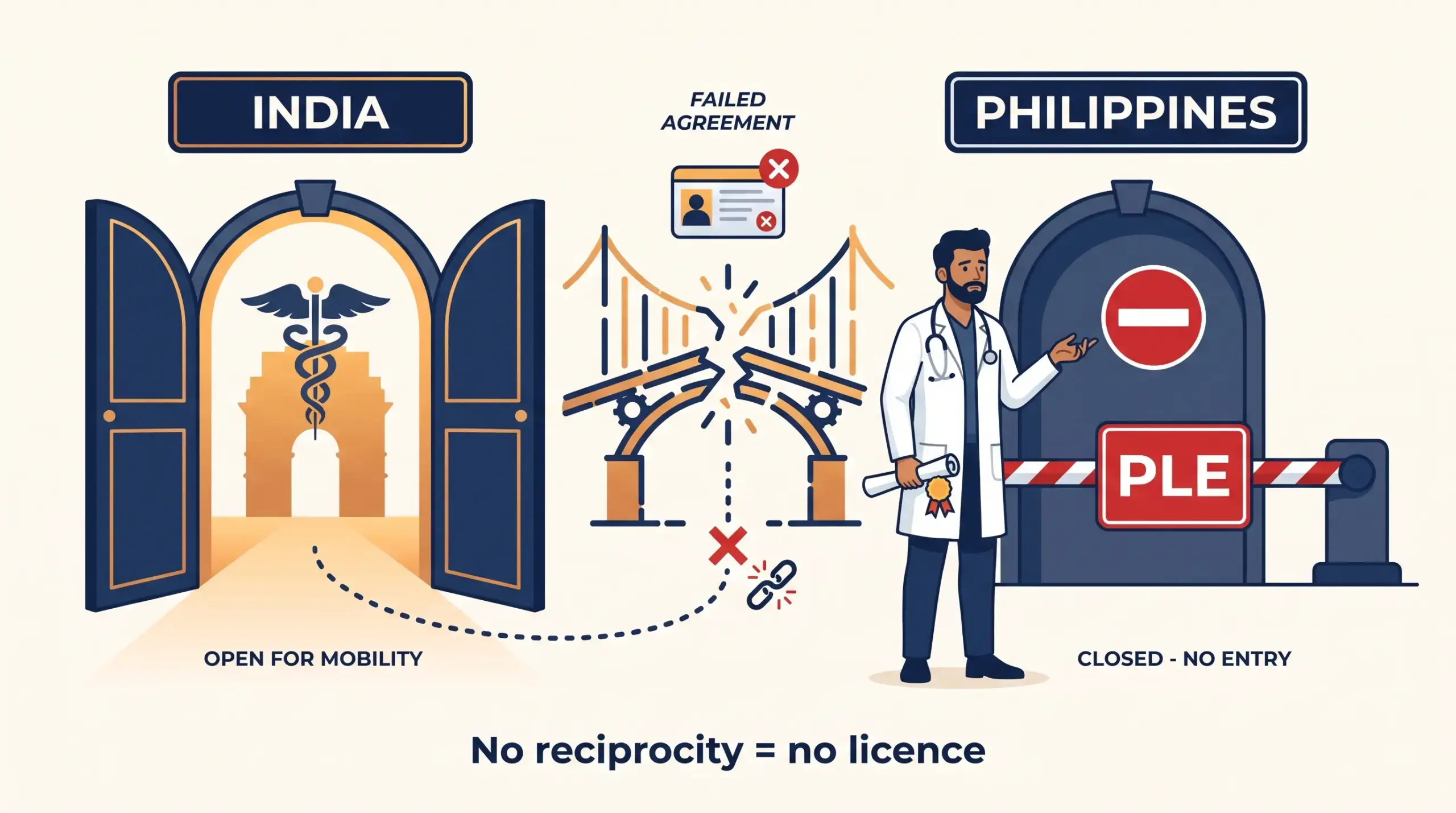
To practise medicine in the Philippines — even to be eligible for a licence there — you must pass the Philippine Physician Licensure Examination (PLE). But under Philippine law, a foreigner may sit the PLE only if their home country lets Filipino doctors practise on the same terms. That is called reciprocity. And between India and the Philippines, that reciprocity does not exist yet.
You do not have to take our word for it. This is the Embassy of India in Manila, writing in its official advisory dated 17-06-2026[2]:
“… foreign medical graduates can take the PLE only if the laws of their country permit Filipino citizens to practice medicine under the same rules and regulations that govern their own citizens. Guidance from the competent authorities in India on establishing the reciprocity required under Philippine laws is awaited.”
— Embassy of India, Manila, Advisory on Medical Education in the Philippines, 17-06-2026 (point 4)[2]
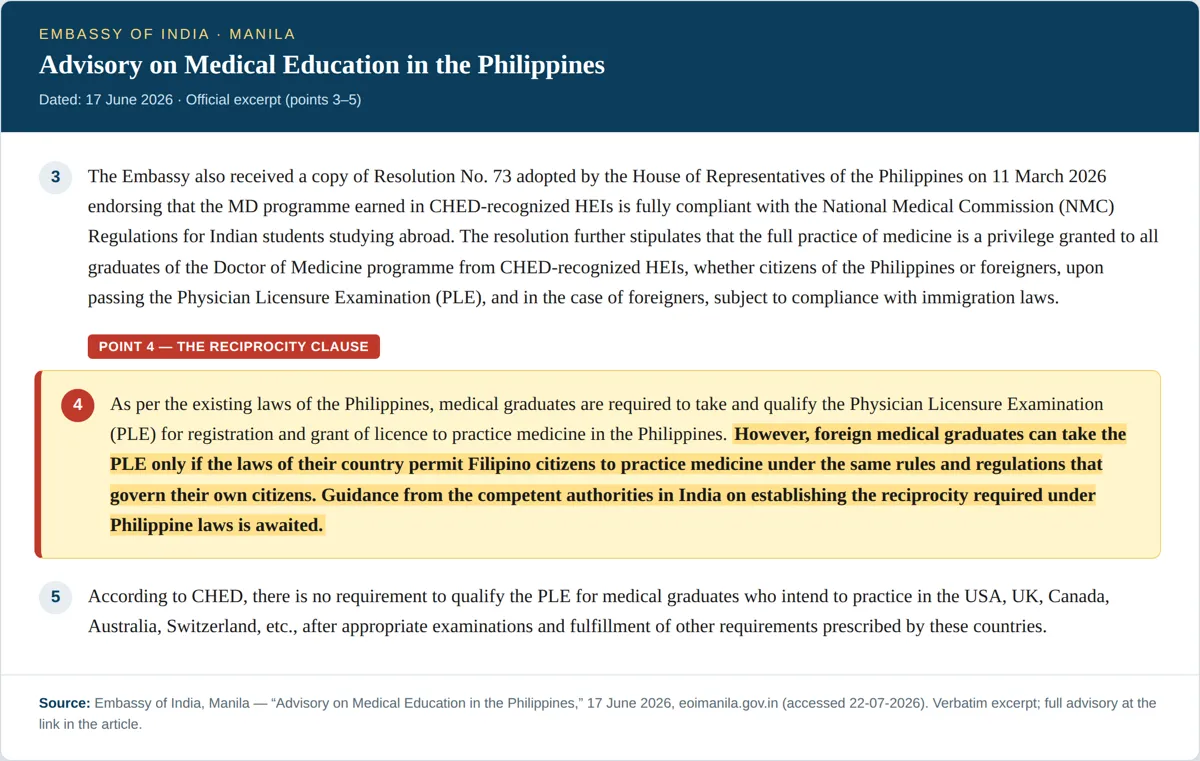
Read slowly what that means for a student sitting there today. You can finish the MD. You can be a fine doctor. But as things stand, you cannot sit the PLE, so you cannot become eligible to be registered to practise in the Philippines — and being eligible to be registered to practise in your country of study is precisely what FMGL 2021’s third condition demands.
In plain terms: as of today, an Indian student who finishes the MD cannot even sit the PLE. The exam is closed to Indian graduates until India and the Philippines sign that mutual agreement — and the Embassy says that guidance is still “awaited.” No PLE means no Philippine licence; no Philippine licence means FMGL 2021’s third condition cannot be met. That is the whole problem, in one line.
The Philippine MD path, start to finish — and where it stops
Put the brochure down and walk the actual road, step by step. This is the journey an Indian student takes in the Philippines, under today’s rules:
- Pre-medical degree first (BS or BA) — about 1.5 years. This is not medicine. It is the college degree you need before you can even apply to medical school.
- Clear the NMAT — with at least a 40th percentile rank. The National Medical Admission Test is compulsory, and admission to the MD requires a minimum NMAT percentile rank of 40. Miss it, and you don’t get a seat.[5]
- The MD itself. Marketed as “4 years,” but the official Doctor of Medicine programme is 54 months — 4.5 years.[2]
- A one-year internship in the same institution or its attached hospital.
- The PLE — which, as things stand, you cannot sit. No India–Philippines reciprocity means no PLE for an Indian graduate.[2]
- You return to India — and under today’s rules you can practise in neither country. No PLE means no licence to practise in the Philippines; and failing FMGL 2021’s third condition means no eligibility to be licensed in India either. A degree you cannot use on either side.
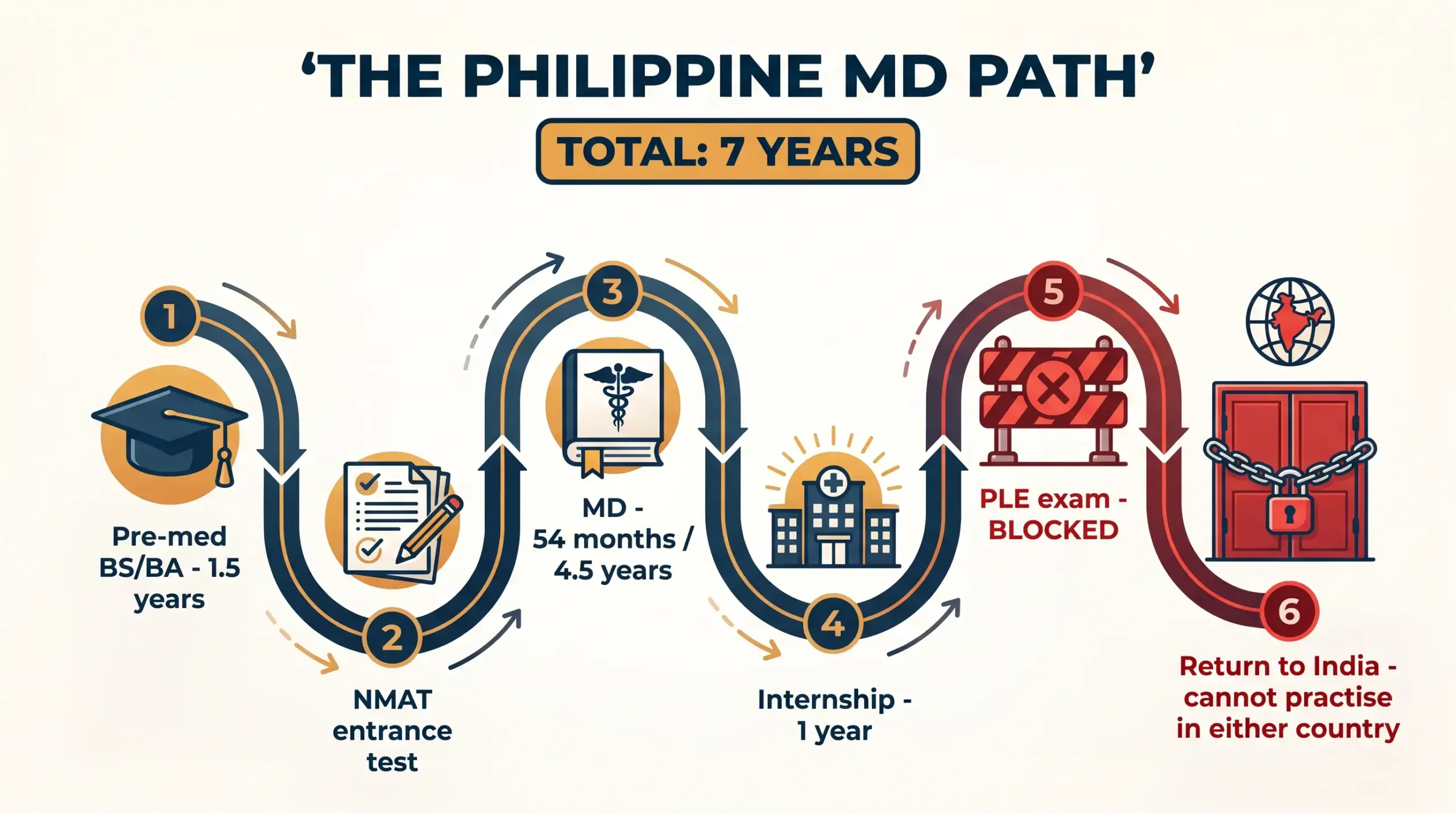
“Neither country” is the phrase that matters, so let us be precise. There is one narrow escape hatch, and the Embassy itself notes it: countries like the USA and the UK do not require the Philippine PLE, so in theory a graduate could instead sit their licensing exams — the USMLE for America, the PLAB for Britain — and build a career there.[2] But be honest with yourself about that road. It is a separate, far harder and costlier path, with its own tough exams and fierce competition for training posts, and it is nothing like the plan the “MBBS in Philippines” brochure sold you. For the overwhelming majority of families whose dream is to wear the white coat back home in India, it does not solve the problem.
That is the part the “only two seats left” phone call never mentions.
Before any of that: your NEET score must be qualified, genuine — and still valid
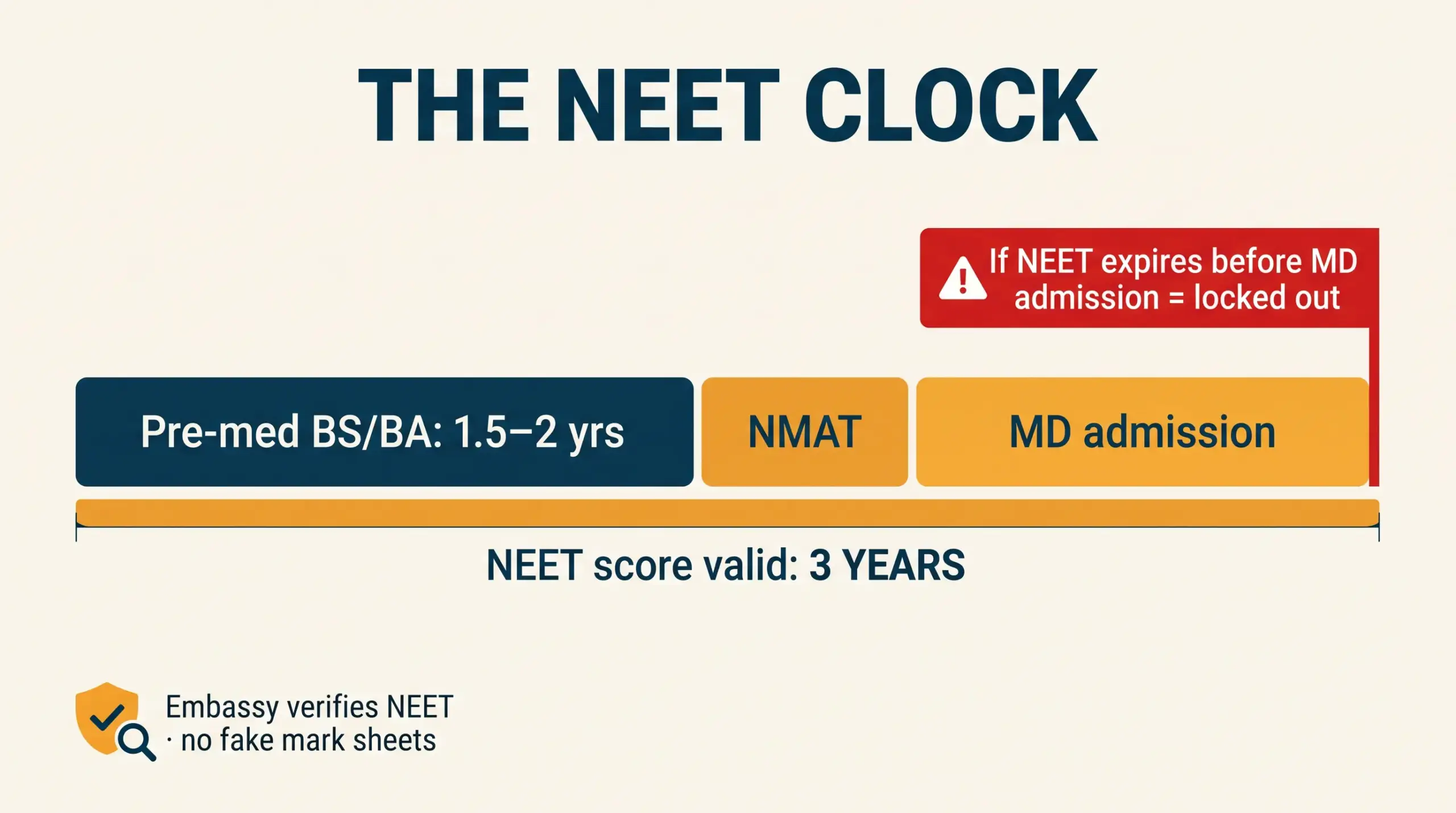
Here is the trap that catches families who were sold the Philippines as an “easy” back door. You do not escape NEET by going there. You run into it — twice.
First, NEET is checked at the door. To go to the Philippines at all — even for the pre-medical BS or BA, before a single day of medicine — you must have qualified NEET, and it is verified. Show up without a genuine NEET pass, or worse, with a doctored mark sheet, and you are not just risking a rejected file. You risk being blacklisted, your papers flagged, and your medical future finished before it began. A forged mark sheet is not a shortcut — it is the fastest way to end everything.
Second, your NEET score has a shelf life. For foreign medical admission, a NEET result is valid for three years.[6] Sounds like plenty — until you see what the Philippine road spends before you ever reach the MD: roughly 1.5 to 2 years on the pre-medical BS/BA and clearing the NMAT. If that three-year window closes during that stretch, you can finish the pre-med, pass the NMAT — and still be locked out of the MD, because the very score that let you begin has expired.
So two questions belong at the top of your list: Is my NEET genuinely qualified and verifiable? And will it still be valid on the day I enrol in the MD — not the BS, the MD?
“But the Embassy also said the MD is compliant” — so who is right?
Here is where an honest article has to slow down, because the truth is not a slogan. Both of these things are true at the same time, and a good counsellor will tell you both.
On one side, the Philippine Commission on Higher Education (CHED) has formally told our Embassy that its MD programme is built to match the FMGL requirements. The same 17-06-2026 advisory records CHED’s position: a 54-month Doctor of Medicine programme (counted separately from the pre-medical BS/BA), the mandatory subjects listed in the NMC’s notification dated 18-11-2021[3], English as the medium of instruction, and a 12-month internship in the same institution. The Philippine House of Representatives even passed Resolution No. 73 on 11-03-2026 declaring the MD “fully compliant” with NMC rules for Indian students. These are the very screenshots in Aarav’s brochure. They are real.
On the other side sits point 4 — the reciprocity gap — and the Embassy’s own closing instruction. It does not say “come” and it does not say “don’t.” It says something more careful:
“Prospective students who intend to take admission in CHED-recognized medical institutions in the Philippines and intend to return and practice in India should verify and satisfy themselves that all NMC-prescribed conditions and criteria are met.”
— Embassy of India, Manila, 17-06-2026 (point 6)[2]
So who is right? Both — and that is the point. The course structure may well be compliant. The licence to practise there is not available to Indians today. A degree can satisfy two of the three conditions and still leave you stranded on the third. The brochure shows you the two green lights. It stays very quiet about the red one.
What this actually means for you — in plain words
Not “Philippines is a scam.” Not “Philippines is fine.” Both of those are lazy. The honest position is narrower and far more useful:
As of today, a critical piece — the ability of an Indian graduate to be licensed to practise in the Philippines — is unresolved, and the Government of India has publicly said so. That is not a rumour from a forum. It is the Embassy of India[2] and the Health Minister saying the same thing.
Things may change. India and the Philippines could sign the reciprocity that unlocks the PLE tomorrow, and if they do, the picture shifts. But you are not paying tomorrow’s fees. You are being asked to pay this Friday, on today’s rules. And on today’s rules, the third pillar is not standing.
So before you transfer a single rupee — to the Philippines, to any country, to anyone — run the same three-question check the government itself is pointing you toward.
The “Check Before You Pay” test
Ask the counsellor these three questions, and ask for the answer in writing:
- NEET: Is my NEET qualification on record and valid for this admission? (If a counsellor brushes this aside, treat it as a warning sign.)
- Structure: Is the medical course at least 54 months, with the NMC’s required subjects, and completed entirely in one institution and one country? Show me where the pre-medical portion ends and the medical degree begins.
- Licence to practise there: On the day I graduate, will I be eligible to be registered to practise medicine in this country — on the same terms as its own citizens? Show me the official document that says so.
Any counsellor confident in their country will answer all three on the spot, with official paper. Hesitation on question 3 tells you what you need to know.
Not sure how your shortlist scores on the three conditions?
Book a free 15- or 30-minute online meeting — no payment, no pressure. Bring any country and college you are weighing, Philippines or anywhere else, and we will walk through the same FMGL 2021 checklist with you using official sources only, so you can decide for yourself.
Rakesh closed his laptop that night without pressing pay. Not because the Philippines is villainous — but because he finally knew which question to ask. The seat that “only two left” could wait one more day. His son’s decade could not be rushed by a Friday deadline.
Verify before you pay. It is the cheapest insurance you will ever buy.
Is MBBS in the Philippines valid for a student who wants to come home and practise in India? As things stand today, our honest answer is no — don’t risk it. On paper the MD may meet the course rules, but with no India–Philippines licence reciprocity in place, an Indian graduate cannot get registered to practise there, and that single gap breaks FMGL 2021’s third condition. The day that reciprocity is signed, we will update this page. Until then, it is not a bet worth placing with your one NEET score, roughly ₹40 lakh, and seven years of your life.
Frequently asked questions
Is MBBS in Philippines valid in India in 2026?
There is no “MBBS” in the Philippines — the qualification is a pre-medical BS or BA followed by an MD (Doctor of Medicine). Whether that MD lets you practise in India depends on the FMGL 2021 conditions. Philippine authorities (CHED) state the 54-month MD meets the course-structure requirements, but as per the Embassy of India’s advisory dated 17-06-2026, Indian graduates currently cannot sit the Philippine licensure exam (PLE) because India–Philippines reciprocity is not yet in place. Verify this status directly before enrolling.
If the Philippines has this problem, why are so many agents promoting it so heavily?
Because two of the three boxes genuinely tick — and those are the two that are easy to sell. The Philippine MD’s course structure is real, CHED has certified it, and there are official-looking screenshots to wave in front of you. The one box that does not tick — the licence-to-practise-there condition — is a quiet, technical clause that is easy to leave out of a glossy brochure. Add the commercials to that: overseas medical admissions run on per-seat commissions, intake targets, and “only two seats left” urgency, so the incentive is to close the booking today, not to walk you through a reciprocity gap that might cost the sale. None of this means the colleges are fake. It means the person selling to you is paid to show you the two green lights and stay quiet about the red one — which is exactly why the Embassy tells you to verify for yourself, and why we built the three-question test above.
Can Indian students practise in India after doing MD in the Philippines?
Only if they satisfy all FMGL 2021 conditions — including being eligible to be registered to practise in the country of study — and then clear India’s licentiate/exit examination. The unresolved reciprocity issue with the Philippines affects the “eligible to practise there” condition, which is why the Embassy advises students to satisfy themselves that every NMC condition is met first.
Is NEET required to study medicine in the Philippines?
Yes. Qualifying NEET is mandatory before taking admission in any foreign medical course if you intend to practise in India. Be cautious with any counsellor who tells you NEET is optional for a foreign medical seat.
What is the “reciprocity” problem with the Philippines?
Under Philippine law, a foreign graduate can take the Physician Licensure Examination (PLE) only if their home country allows Filipino citizens to practise medicine on the same terms. India and the Philippines have not established this reciprocity yet, so — per the Embassy of India’s advisory of 17-06-2026 — Indian graduates currently cannot sit the PLE.
Is the Philippine MD “NMC-compliant,” as some brochures claim?
CHED states the MD course structure is built to meet the FMGL requirements, and a Philippine House resolution (No. 73, 11-03-2026) endorses this. However, “compliant course structure” is not the same as “you can practise there.” The licence-to-practise condition remains unresolved for Indians. Treat “100% compliant” claims with caution and ask for the third condition in writing.
Sources & references
- Foreign Medical Graduate Licentiate (FMGL) Regulations, 2021 — National Medical Commission (official). Read the regulation (PDF).
- Embassy of India, Manila — Advisory on Medical Education in the Philippines, 17-06-2026. See especially point 4 (reciprocity / PLE) and point 6 (verify before enrolling). Read the advisory on the Embassy website · archived backup copy.
- NMC notification dated 18-11-2021 — Schedule-I mandatory subjects, referenced within the FMGL Regulations, 2021. National Medical Commission — Rules & Regulations.
- Union Health Minister — clarification in Parliament on the NMC Gazette and conditions for studying medicine abroad (video). Watch the clip.
- CHED Memorandum Order No. 18, s. 2016 — Doctor of Medicine Program (Commission on Higher Education, Philippines; governs MD admission, including the NMAT percentile-rank requirement). Read the order (PDF).
- NEET-UG score validity for foreign medical admission — a NEET result is valid for three years for admission to foreign medical courses (National Medical Commission). NMC — For Students to Study Abroad.