
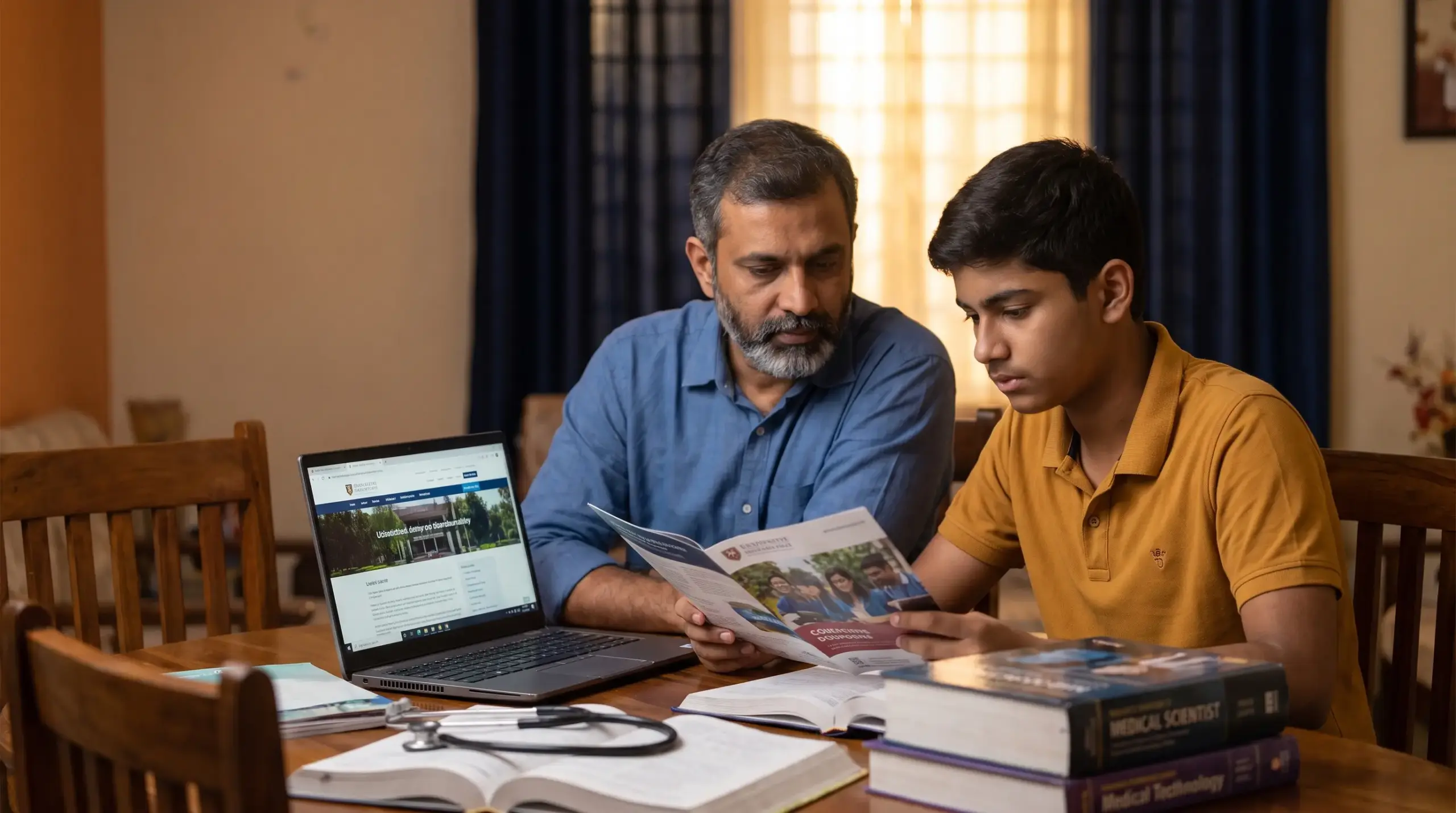
A parent called us last month with a brochure in his hand. His son had cleared NEET with a score that would not reach a government seat, and a consultant had offered him the Philippines with one line that sealed it: “After the MD, he can clear the board exam and practise there itself.”
He wanted to know if it was true.
It took us four hours of reading government documents to answer him properly. Here is the whole answer, laid out step by step, so you do not have to.
In 30 seconds
- The Philippine board exam (the PLE) is real — but a foreigner can only sit it if their country has a “reciprocity” arrangement with the Philippines.
- Reciprocity means India must let Filipino doctors work in India on the same terms as Indian doctors. Right now, India does not.
- So the Government of India has said this reciprocity is still “awaited” (Embassy of India, Manila — 17-06-2026).
- Bottom line: today, an Indian student cannot yet sit the PLE — whatever a brochure promises.
Can an Indian student take the PLE right now?
Follow the arrows — the whole article, in one picture
- The exam is real — that is exactly why the promise sounds real
- What the Philippine medical path actually is
- How a foreign graduate is meant to qualify for the PLE
- The clause that decides everything is an Indian one
- Why it is stuck — and why it is stuck on our side
- This is Step 5 of the audit we run on every college
- Passing the PLE is not the same as practising in India
- Has any Indian actually passed the PLE?
- Already studying in the Philippines? What to do now
- The calmer third way
- Four questions to ask before you pay anyone
- Frequently asked questions
The exam is real — so the promise sounds real
The Physician Licensure Examination (PLE) genuinely exists, and it is a serious exam. It is administered by the Professional Regulation Commission (PRC) through its Board of Medicine, under the Medical Act of 1959 (Republic Act No. 2382, as amended).
The structure is a matter of public record. The examination covers 12 subjects — four preliminary (Anatomy and Histology, Physiology, Biochemistry, Microbiology and Parasitology) and eight final (Pharmacology, Pathology, Medicine, Obstetrics and Gynaecology, Paediatrics and Nutrition, Surgery, Preventive Medicine and Public Health, and Legal Medicine, Ethics and Jurisprudence).
The PLE at a glance
The whole board exam, in six numbers
The same rules, in words
- Examined across four days over two consecutive weekends — the October 2025 sitting ran on 4, 5, 11 and 12 October, three subjects a day.
- Held twice a year, the two sittings six months apart — recently around March and October.
- To pass: a general average of at least 75%, with no single subject below 50%.
- Fail the complete examination three times and you must complete a one-year refresher course at a recognised medical school before sitting again.
The results are published openly, and they show a demanding exam. In the most recent official releases, 1,901 of 3,827 candidates passed in March 2025 (about 49.7%), 4,570 of 5,900 in October 2025 (77.46%), and 1,954 of 2,781 in March 2026 (70.26%). The larger October sitting posted the higher pass rate; the numbers swing from one sitting to the next.
All of that is verifiable. And because it is verifiable, the promise built on top of it sounds verifiable too. That is the trap.
What the Philippine medical path actually is
Start with a plain fact that most brochures blur: the Philippines does not award an “MBBS.” It is a US-style system. A student first completes a pre-medical bachelor’s degree, then a separate four-year Doctor of Medicine (MD) that ends in a post-graduate internship, and only then is eligible to attempt the PLE.
Add it up and the Philippine route to a practising licence is materially longer than the “5-and-a-half-year MBBS” many families picture. We break the full timeline and the 54-month duration rule down in the main Philippines guide. For this page, hold on to one point: everything above is the study path. Whether an Indian passport-holder may even sit the exam at the end of it is a separate question — and it is the one that matters.
How a foreign graduate is meant to qualify for the PLE
The PRC does not simply let any medical graduate walk in. For a foreign national, its standing public advisory sets out a specific documentary trail. A foreign applicant must, among other things, submit:
- a birth certificate, diploma and transcript of records;
- a CHED certificate of equivalency for the foreign degree;
- a post-graduate internship certificate (required for physicians);
- an official request letter from the appropriate government authority in the applicant’s country;
- and proof of reciprocity — an international agreement or reciprocal law.
Documents executed abroad must be apostilled or authenticated by a Philippine embassy or consulate, and applications with incomplete requirements are rejected. Notice which item on that list has no Indian equivalent to produce. Hold that thought — it is the whole story.
Eligibility is decided by an Indian law, not a Philippine one
Philippine law does not simply ask whether you hold a medical degree. For a foreign national it asks a second question first — a reciprocity question.
In plain terms: can a Filipino doctor come to your country and practise on the same terms as your own citizens? If yes, you may sit the PLE. If no, you may not.
In 2023, PRC guidance confirmed that foreign citizens holding a Doctor of Medicine degree from a CHED-recognised college of medicine may, in principle, take the PLE. That is the source of nearly every “Indians can now practise in the Philippines” headline you have seen since.
But the PRC’s standing advisory for foreign nationals was never withdrawn. It states plainly that proof of reciprocity between the Philippines and the applicant’s country “is one of the requirements for taking the Licensure Examination and cannot be dispensed with.” Every foreign applicant must produce it individually.
So which is it for India? The Government of India has answered that question directly.
In its advisory dated 17 June 2026, the Embassy of India in Manila states that foreign medical graduates can take the PLE only if the laws of their country permit Filipino citizens to practise medicine under the same rules that govern their own citizens — and that guidance from the competent authorities in India on establishing this reciprocity is still awaited.
Read that last word again. Not “granted.” Not “in process.” Awaited.
Why it is stuck — and why it is stuck on our side
India does not give foreign doctors a full, permanent licence to practise here. A foreign doctor can get only a temporary permit — for a short time, and usually tied to one named hospital or college for teaching or training (in the law, this is Section 34 of the NMC Act, 2019).
That is not practice on the same footing as an Indian citizen. So when an Indian applicant is asked to prove that Filipinos may practise in India on equal terms, there is presently nothing to hand over. The reciprocity clause is not blocked by a Philippine official refusing a form — it is blocked because the matching Indian permission does not yet exist to point to.
Let us be fair about what this is and is not. It is not a Philippine rejection of Indian students. It is a gap between two countries’ rules that neither government has closed yet. It may well be closed in future. It is simply not closed today.
This is Step 5 of the audit we run on every college
Before we recommend any college to any family, we run a five-step check. We call it the FMGL Risk Elimination Audit, because it maps to the rules under which your child will actually be registered in India — the National Medical Commission’s Foreign Medical Graduate Licentiate (FMGL) Regulations, 2021.
The 5-Step FMGL Risk Elimination Audit
Where the Philippines route currently stops for an Indian passport-holder
Sources: PRC foreign-nationals advisory · Republic Act No. 2382 · NMC Act, 2019 · Embassy of India, Manila (17-06-2026)
The Philippines route can look strong on the first four steps and still stop dead on the fifth.
Step 5 is not a formality. FMGL 2021 requires a foreign medical graduate to be registered with, or licensed by, the authority competent to grant a licence in the country where the degree was awarded — at par with the licence given to that country’s own citizens. In the Philippines, that licence is the PLE. You can read how this fits the wider rules in our plain-English guide to FMGL 2021.
So the loop closes on itself: the route home can depend on being licensable there, and being licensable there currently depends on a reciprocity question that has not been resolved.
Passing the PLE is not the same as practising in India
Suppose, for a moment, that the reciprocity gap closes and an Indian graduate does clear the PLE. Even then, a Philippine licence on its own does not let anyone practise in India. It is a Philippine document, recognised by Philippine authorities, for practice in the Philippines.
To register and work as a doctor in India, a foreign medical graduate must separately satisfy the NMC’s FMGL 2021 conditions and qualify India’s own licensing examination — currently the Foreign Medical Graduate Examination (FMGE), which is being replaced by the National Exit Test (NExT) — and complete the required internship. The Philippine board exam and the Indian licence are two different doors. Clearing the first does not open the second.
Has any Indian actually passed the PLE?
There is no official record either way — and that itself is the point.
With every result release, the PRC publishes total examinees, total passers, topnotchers and school-wise performance. It does not publish a nationality breakdown. We could find no PRC, CHED or Embassy record confirming that an Indian national has sat the PLE, let alone passed it.
You may come across a consultancy website naming a specific Indian graduate who supposedly cleared the exam and now practises in Manila. Those claims carry no PRC citation, no year and no licence number, and we could not corroborate them against any official record.
So here is a test you can run yourself. If someone tells you Indian students are already passing the Philippine board exam and settling there, ask for one verifiable PRC registration number. A real one takes thirty seconds to check on the PRC roster. A story without a number is marketing copy.
Already studying in the Philippines? What to do now
If your child is already enrolled, do not panic and do not make a sudden decision from a single blog post — ours included. The situation is a policy gap, not a verdict on your child. Here is the calm, practical sequence we would follow:
- Get the facts in writing from the college. Ask, on email, exactly how their foreign graduates become eligible for the PLE, and for the specific reciprocity document they rely on for Indian students.
- Confirm the Indian side directly. The controlling document today is the Embassy of India (Manila) advisory. Re-read the current version before any fee milestone; a government position can change, and you want the latest, not last year’s.
- Protect the parts that transfer. Keep every transcript, syllabus, internship record and duration certificate in order. If a decision has to be made later, clean documentation is what preserves your options.
- Get an independent, documents-based read. Not from the agent who enrolled the student, and not from us on trust — from anyone willing to show you the government pages behind each answer.
The calmer third way
The debate is usually framed as two bad options: gamble on the Philippines, or give up on medicine. That is a false choice.
None of this makes the Philippines a bad place to study medicine. It is an English-medium system with a well-established MD structure and a regulator that publishes its results openly — which is more than can be said for several destinations being sold harder. The problem is narrower and more specific: the promise that a graduate can finish there, clear the PLE and practise, rests on a reciprocity requirement the Government of India has confirmed is unresolved as of June 2026.
The third way is neither hope nor panic. It is verify before you pay. Ask for the licence rule in writing, for every country on your shortlist, before a rupee moves. A destination that clears all five steps of the audit — including Step 5 — is worth far more than one that looks cheaper or faster on the brochure and stalls at the licence. That may change your shortlist. It should.
Governments do negotiate these things, and the Philippines may open to Indian graduates in time. But you cannot build six years of your child’s life, and your family’s savings, on a change that has not happened yet.
Four questions to ask before you pay anyone
- Show me the reciprocity document. If an Indian can sit the PLE today, there is a document establishing India–Philippines reciprocity. Ask to see it.
- Show me one verifiable PRC licence number belonging to an Indian graduate.
- Which specific FMGL 2021 condition does this route satisfy, and how? Ask them to point at the clause, not the brochure.
- What is the plan if reciprocity is never granted? A serious advisor has an answer. A salesperson changes the subject.
Where this leaves your decision
The specific promise doing the rounds right now — that your child can finish an MD in the Philippines, clear the PLE, and practise there — rests on a reciprocity requirement that the Government of India has publicly confirmed is unresolved as of June 2026. It may change. It has not changed yet.
Whatever destination you are considering, run Step 5 before you pay, not after your child graduates. Ask for the licence rule in writing. If a college or consultant will not put it on paper, that is your answer.
Frequently asked questions
Can Indian students take the Philippine Physician Licensure Examination?
What is the PLE and how is it structured?
How long is the medical path in the Philippines?
What documents does a foreign national need to sit the PLE?
Has any Indian national passed the PLE?
Why can’t India meet the reciprocity requirement right now?
If someone passes the PLE, can they practise in India?
Check before you pay — including with us.
Book a free FMGL Risk Audit. We will walk your shortlist through all five steps, show you the government documents behind each answer, and tell you honestly where the risk sits.
— Siddarth Jaiswal, Founder, National Vidya Foundation
Sources
Every figure and rule above traces to an official government or regulator source. Each link below opens the original document (new tab).
- Embassy of India, Manila — Advisory on Medical Education in the Philippines, 17-06-2026. The controlling source on reciprocity status.
- Professional Regulation Commission — Public Advisory on Foreign Nationals taking Philippine Licensure Examinations.
- PRC — official PLE result releases: March 2025, October 2025 and March 2026.
- PRC — October 2025 PLE Program / examination schedule (PDF).
- Republic Act No. 2382 — the Medical Act of 1959 (as amended), §18 and §21 (PRC-hosted text).
- National Medical Commission (India) — Foreign Medical Graduate Licentiate (FMGL) Regulations, 2021, and the NMC Act, 2019 (Section 34).