
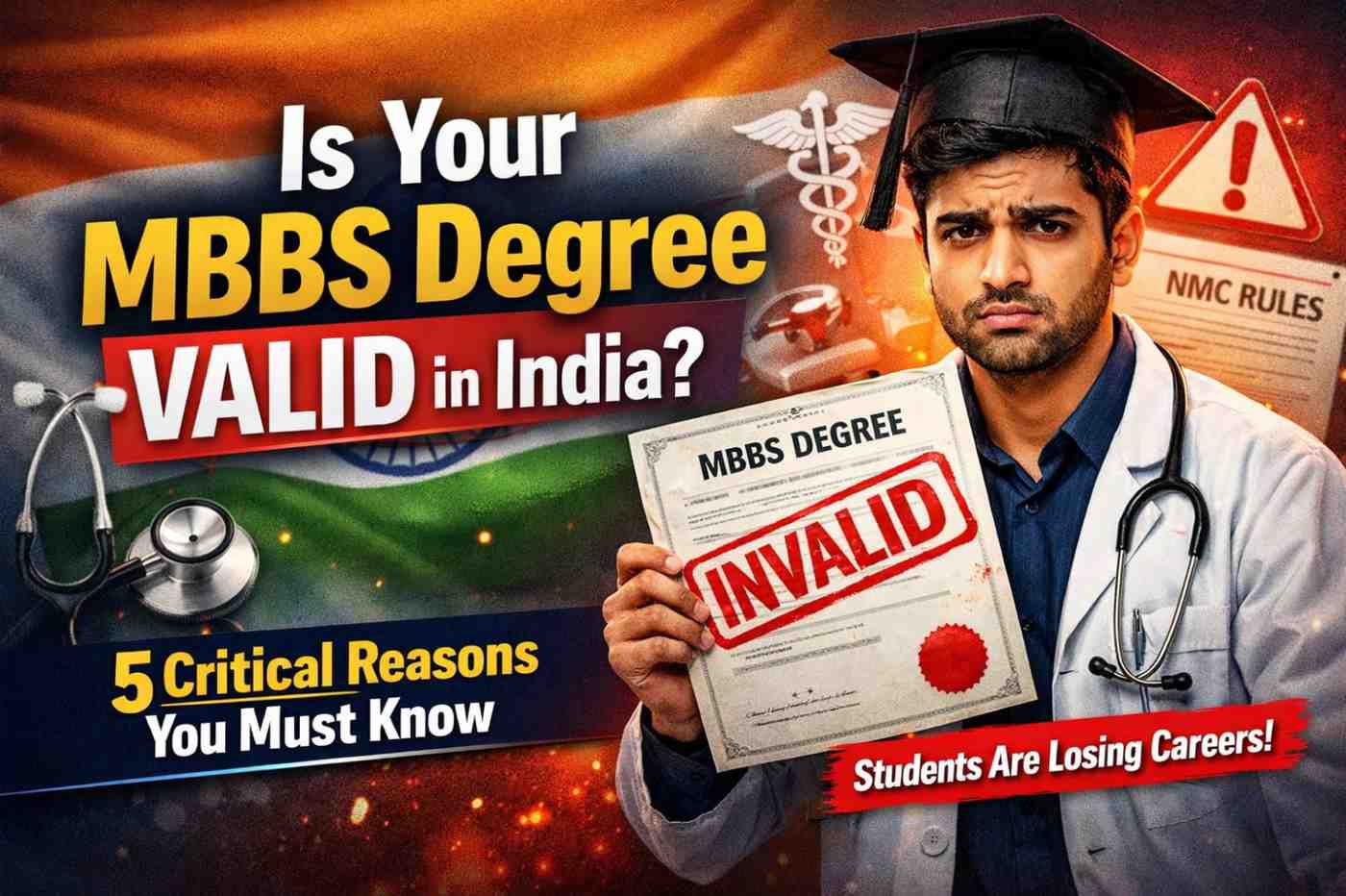
The dream of becoming a doctor often leads Indian students to international shores. However, since the National Medical Commission (NMC) released the Foreign Medical Graduate Licensure (FMGL) Regulations 2021, the rules of the game have changed entirely.
Today, getting an MBBS admission is easy, but getting a license to practice in India is becoming nearly impossible for many. If your chosen college fails even one of the following five criteria, your degree is effectively a piece of paper with zero legal value in India.
- The 54-Month Theory Trap
The NMC is non-negotiable on the duration of the course. Your medical course must have a minimum duration of 54 months (4.5 years) of theoretical and practical study. Many universities in the Philippines or other regions previously tried to bridge this with “pre-med” or shorter terms. If the core MD/MBBS program is even one month short of the 54-month requirement, you will be disqualified from the NExT exam.
- The “Same Campus” Internship Rule
This is where most students get stuck. The law states you must complete a 12-month internship in the same foreign medical institution where you studied. You cannot study in one city and do your clinical rotation in another country or a non-affiliated hospital. If the college doesn’t have its own dedicated teaching hospital with a high patient inflow, your internship will not be recognized.
- The “Medium of Instruction” Deception
The regulations strictly mandate that the entire course must be taught in English. Beware of “Bilingual” programs where the first three years are in English and the clinical years are in the local language (like Russian, Mandarin, or Uzbek). If your transcripts don’t prove 100% English medium for all 54 months, the NMC will reject your registration.
- Registration in the Host Country
You must be eligible to register and practice as a doctor in the country where you studied. If the country grants you a degree but does not allow “foreigners” to get a local license, you are ineligible to sit for the NExT in India. Many popular “budget” destinations have laws that prevent Indians from getting a local license—this is a massive legal trap.
- The Clinical Hands-on Gap
The FMGL 2021 requires hands-on clinical training. Many universities are currently overcrowded, with 50 students standing behind one bed. If you cannot prove actual clinical hours and hands-on patient interaction during your 12-month internship abroad, you will face severe hurdles during the NMC’s document verification process.
How NVF Foundation Protects Your Career
At NVF Foundation, we don’t just process “admissions”—we provide Legal Compliance Audits. We understand that for a parent, this is not just an investment of money, but an investment of their child’s life.
What We Offer:
- A 9-Point Compliance Audit: Before we recommend a college, we verify its 54-month structure, internship validity, and local licensing laws with local legal experts.
- “Born Compliant” Institutions: We primarily focus on institutions like Nalanda College of Medicine (Timor-Leste), which were built after 2021 specifically to meet these NMC laws.
- Direct Indian Management: We ensure the clinical training is overseen by Indian faculty who understand the requirements of the NExT exam.
- Regional Indian Logistics: From “Desi” mess food to 100% English environments, we manage the lifestyle so the student can focus on medicine.
Why You Should Choose NVF Foundation:
- 24 Years of Honesty: We are not agents; we are mentors. If a college is risky, we will tell you the truth, even if it means losing an admission.
- Zero Hidden Traps: Our budget sheets are transparent. We account for every rupee, from the first flight to the final licensing exam.
- NExT Focused Training: Our students don’t just get a degree; they get integrated coaching to ensure they pass the Indian licensing exam on their first attempt.